But first, let’s figure out what both Angular and React actually are.
What Is Angular?
First, not to mix everything up: I’m talking about Angular 2, not AngularJS (which is a different and older framework.)
Right now Angular 2 is used as an umbrella term for all the versions of Angular released after AngularJS. They are Angular 2, 4, 5, 6, 7, 8, and 9 (released on Feb 6, 2020).
What is Angular 2 exactly? It’s an open-source framework mainly used for creating web apps, single-page web apps, and hybrid apps. Angular is built on TypeScript, developed and maintained by Google.
Angular is a full-fledged toolkit that has everything developers need to build large-scale apps. No wonder it gains popularity: leading businesses, like Xbox, Forbes, BMW, and many more choose Angular over React for front-end development.
Projects built with Angular:
- Samsung Forward
- Microsoft Office Home
- Forbes
- BMW Driveaway Price Calculator
What Is React?
ReactJS (or React.js/React) was developed by Facebook as a front-end Javascript library for building user interfaces (UI). React uses a declarative style of programming to describe the UI state.
React allows programmers to figure out how their app is going to look for users and how they would interact with it. It’s also used for building web apps, as well as native-rendered apps, and even mobile applications.
Facebook used React over Angular in production for years, along with Instagram, Netflix, and other tech giants. But it works for small projects too.
Here are some of the small ones to give you an idea:
- Unit Converter
- Radix Converter
- BMI Calculator
- Course Learn Page
Data Binding
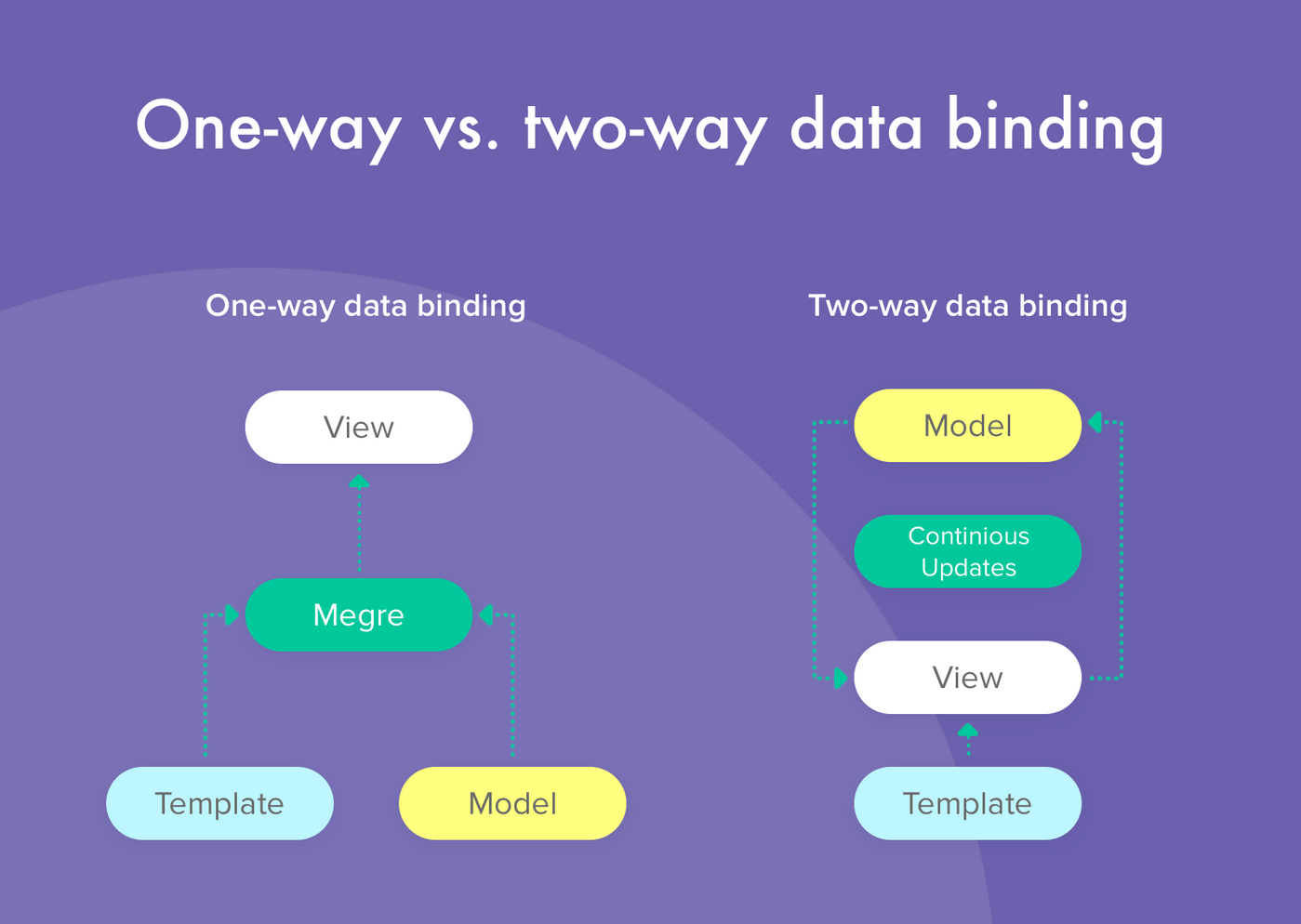
Data binding is about synchronizing data between business logic and UI.
The difference between Angular and React.js is that Angular uses two-way data binding: changing data impacts view and changing view triggers changes in data.
React uses one-way binding: when designing React app developers often nest child components within higher-order parent components.
One-way binding makes the code more stable, and also makes debugging an app build with React versus Angular app much easier. Still, the two-way binding of Angular is simpler to work with.